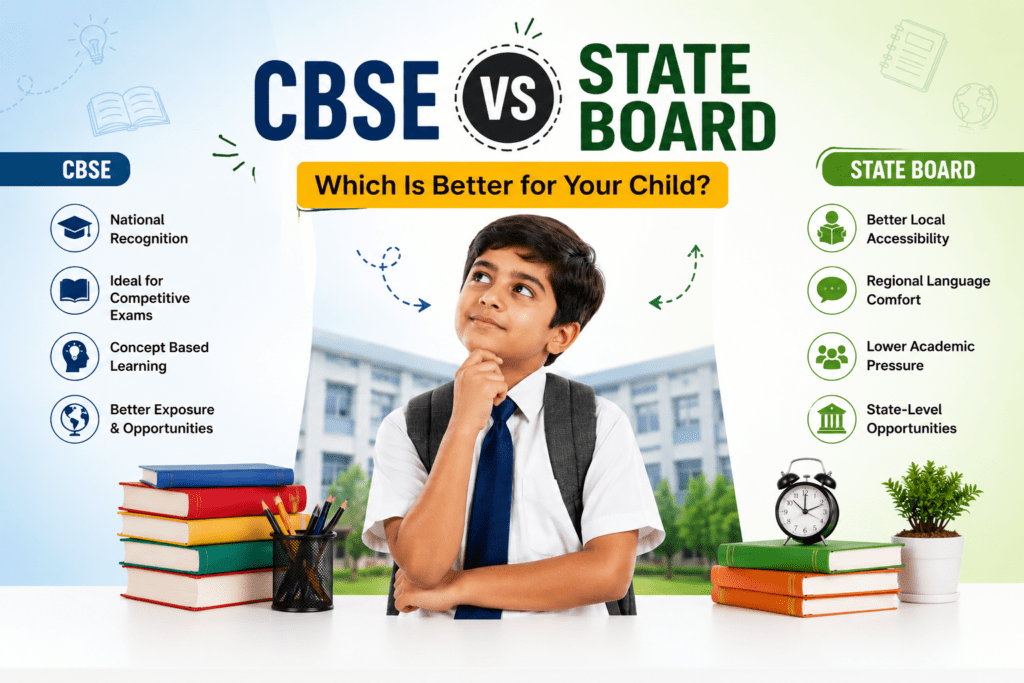
One of the most common questions parents ask while choosing a school is: CBSE vs State Board — which is better for your child?
And honestly, it’s an important question. The education board your child studies under shapes not only academic learning, but also future opportunities, competitive exam preparation, communication skills, and overall career readiness.
Both CBSE and State Boards have their own advantages, but the right choice depends on your child’s learning style, goals, and future plans.
Let’s understand the real difference between CBSE vs State Board in a simple and practical way.
What Is The Difference Between CBSE and State Board?
State Board curriculum is managed by the respective state governments. For example, students in Madhya Pradesh follow the MP Board syllabus designed specifically for the state.
CBSE (Central Board of Secondary Education), on the other hand, is a national-level board followed by schools across India and abroad. The curriculum, exams, and learning structure are standardized nationwide.
The major difference between CBSE vs State Board lies in curriculum structure, teaching approach, language focus, and preparation for higher education.
Where State Board Has The Advantage
State Board schools work well for many students, especially in regional settings.
1. Better Local Accessibility
State Board schools are widely available in smaller towns and rural areas, making education more accessible locally.
2. Regional Language Comfort
Teaching often happens in regional languages like Hindi, which helps students who are still developing English communication skills.
3. Lower Academic Pressure
The curriculum may feel comparatively less demanding during the early years, which can suit certain learners.
4. State-Level Opportunities
Some state government exams and reservation systems align more closely with the State Board structure.
Where CBSE Has The Advantage
1. National Recognition
One of the biggest benefits in the CBSE vs State Board comparison is nationwide acceptance. CBSE certificates are recognized across India, making school transfers and college admissions easier.
Whether your child studies in Delhi, Bangalore, Chennai, or Mumbai, the CBSE curriculum remains consistent.
2. Better Preparation for Competitive Exams
CBSE syllabus is closely aligned with major competitive exams like:
- JEE
- NEET
- CUET
This gives CBSE students an advantage while preparing for national-level entrance examinations.
3. Strong Conceptual Learning
CBSE focuses more on understanding concepts, application-based learning, and problem-solving rather than rote memorization.
This helps students build analytical thinking and practical understanding.
4. Better English Proficiency
CBSE schools generally place stronger emphasis on English communication, which is valuable for:
- Higher education
- Career opportunities
- Global exposure
- Personality development
5. Updated and Structured Curriculum
CBSE follows NCERT textbooks, which are regularly updated and considered highly reliable for academic learning and competitive exam preparation.
CBSE vs State Board: Which Is Better for Your Child?The answer depends on your child’s needs and future goals.
Ask yourself:
- Might your family relocate in the future?
- Is your child interested in engineering, medicine, or competitive exams?
- How comfortable is your child with English-medium learning?
- Does your child benefit from structured and concept-based education?
If your answers lean toward mobility, national-level opportunities, and future-focused learning, then CBSE often becomes the stronger choice.
A Good School Matters More Than The Board
While comparing CBSE vs State Board, parents should also remember that school environment matters just as much as the curriculum.
A good school focuses on:
- Concept clarity
- Confidence building
- Student well-being
- Practical learning
- Communication skills
- Holistic development
The right teaching approach reduces pressure and helps children enjoy learning.
Why Aspire International School Follows CBSE
At Aspire International School, we follow the CBSE curriculum because we believe it provides students with a strong academic foundation, future opportunities, and practical learning exposure.
Our approach goes beyond textbooks. We focus on:
- Conceptual understanding
- Critical thinking
- Communication skills
- Confidence building
- Overall personality development
We believe education should prepare students not just for exams — but for life.
Final Thoughts
The debate around CBSE vs State Board does not have one universal answer. Every child learns differently, and every family has different priorities.
However, in today’s competitive and fast-changing world, a curriculum that supports conceptual learning, national-level opportunities, and skill development can provide long-term advantages.
The right school and the right learning environment together create the strongest foundation for a child’s future success.
Parents can also explore our guide on Top 10 Factors Parents Must Check Before School Admission to make a more informed school selection decision.
Register today and take the first step towards a brighter future for your child.
Ready to Join a School That Values Discipline and Growth?
Enroll your child at Aspire International School and set them on the path to lifelong success.