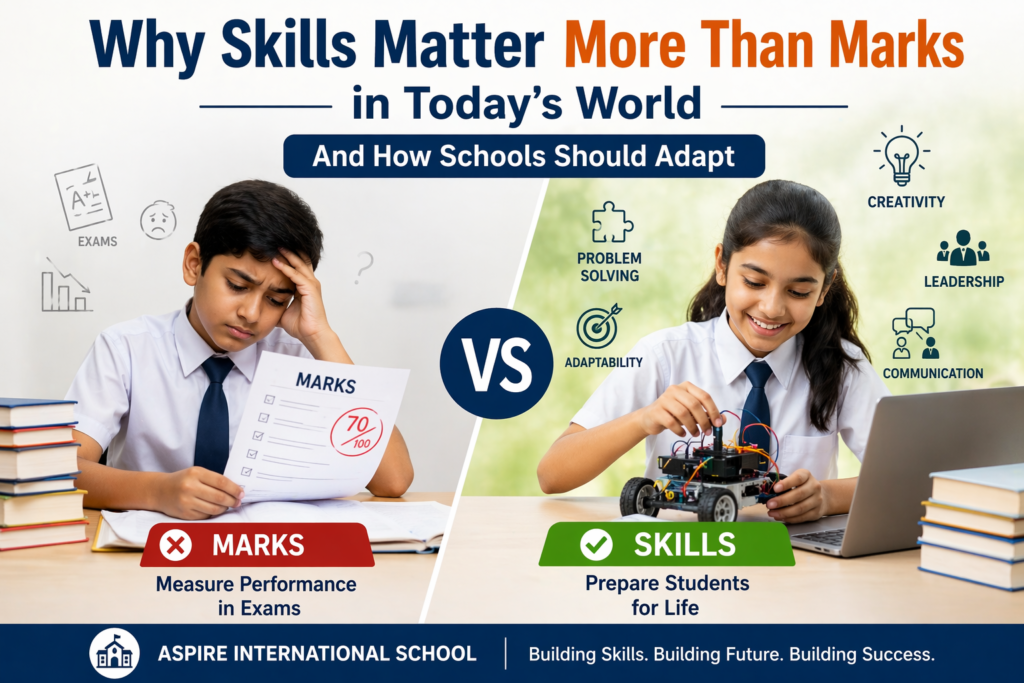
In today’s fast-changing world, the debate around skills vs marks in education is becoming more important than ever.
Success is no longer defined only by report cards and percentages. While marks still matter, skills—both practical and personal—have become the true measure of a student’s potential.
At Aspire International School, this shift towards skills vs marks in education is seen as an opportunity to redefine learning.
The Changing Landscape of Success
Earlier, marks played a major role in shaping a student’s future. But today, the focus has shifted from marks to skills.
In the discussion of skills vs marks in education, employers and universities now value:
- Critical thinking
- Communication skills
- Problem-solving ability
- Adaptability
A student with high marks but low confidence may struggle, while a student with strong skills can excel in real-life situations.
Why Skills Matter More Than Marks in Education
1. Real-World Application
A key aspect of skills vs marks in education is application.
Marks show how well a student memorizes, but skills show how well they apply knowledge in real-life situations.
2. Career Readiness
In the debate of skills vs marks in education, skills play a major role in career success.
Modern careers demand:
- Teamwork
- Digital skills
- Critical thinking
3. Confidence & Personality Development
Skills like communication, leadership, and emotional intelligence build confidence.
This is why skills vs marks in education is not just an academic debate—it impacts personality development.
To understand this better, you can also read our blog on the importance of extracurricular activities in school life.
4. Adaptability in a Changing World
With industries evolving rapidly, adaptability is crucial.
Skill-based learning prepares students to learn, unlearn, and relearn—something marks cannot measure.
Limitations of Marks-Centric Education
Focusing only on marks highlights the problem of skills vs marks in education.
It can:
- Create stress and pressure
- Limit creativity
- Encourage rote learning
- Ignore individual strengths
Education should focus on overall development, not just scores.
How Schools Should Adapt
To address the gap in skills vs marks in education, schools must evolve.
1. Skill-Based Curriculum
Focus on communication, problem-solving, and critical thinking.
2. Experiential Learning
Encourage projects, real-life activities, and practical learning.
3. Co-Curricular Activities
Sports, arts, and debates help build confidence and teamwork.
4. Encouraging Creativity
Allow students to explore ideas without fear of failure.
5. Personalized Learning
Every child learns differently—teaching should adapt.
6. Life Skills Development
Include emotional intelligence, leadership, and decision-making.
Aspire International School’s Approach
At Aspire International School, the focus is on balancing skills vs marks in education.
Students are prepared not just for exams, but for life through:
- Concept-based learning
- Skill development programs
- Holistic education
Final Thought
The debate of skills vs marks in education clearly shows that marks alone are not enough.
Marks may open doors—but skills help students succeed beyond them.
In today’s world, education should focus on preparing students to:
- Think
- Adapt
- Create
- Lead
Because success is not measured by marks alone…
It’s measured by how far a student can go.
Register today and take the first step towards a brighter future for your child.
Ready to Join a School That Values Discipline and Growth?
Enroll your child at Aspire International School and set them on the path to lifelong success.